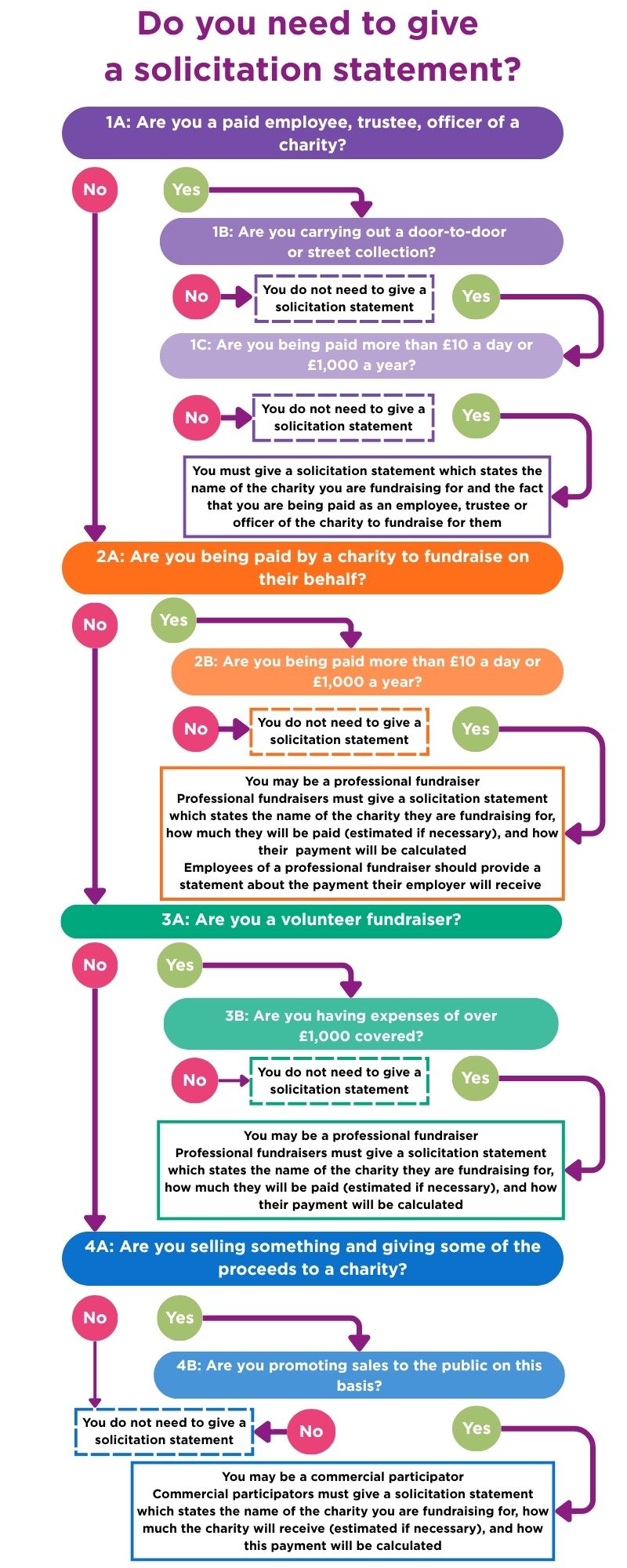
Do you need to give a solicitation statement?

We have created new resources to help simplify the requirements and aid fundraisers in understanding whether solicitation statements are relevant to them.

The resources come in two forms – a flowchart and an interactive quiz - so that they are adaptable and accessible in different settings.

  • The quiz asks a series of questions based on your specific circumstances. It only shows you the information relevant to your situation and provides useful context and explanations alongside the answers.
  • The flowchart is a simpler visual guide and by following the question logic fundraisers can quickly identify whether solicitation statements may be relevant to them. This could also be a useful tool for training fundraisers.
By answering the questions on this page, you can discover whether you may need to give solicitation statements when carrying out your fundraising. 

Solicitation statements are legally required statements that some fundraisers must give when fundraising for a charitable institution. 
These statements outline the relationships between the fundraiser and the charitable institution and explain how the charitable institution will benefit from the fundraising. 

The information on this page does not constitute legal advice and is not exhaustive. 
For more information about the Fundraising Regulator’s expectations regarding solicitation statements and the relevant legal obligations see the following sections of our Code of Fundraising Practice ('the code'):
  • Section 6 on Fundraising Partnerships


Based on the answers you have given, it is unlikely that you need to give a solicitation statement.

Paid employees, trustees or officers of a charity only need to give a solicitation statement if they are carrying out a door-to-door or street collection and are being paid more than £10 a day or £1,000 a year to fundraise.

Based on the answers you have given, it is unlikely that you need to give a solicitation statement.

Paid employees, trustees or officers of a charity only need to give a solicitation statement if they are carrying out a door-to-door or street collection and are being paid more than £10 a day or £1,000 a year to fundraise.
Based on the answer you have given, it is likely that you will need to give a solicitation statement.

This is because you have indicated that you are a paid employee, trustee or officer of a charity who is being paid more than £10 a day or £1,000 a year to carry out a door-to-door or street collection.

Charity staff who this applies to must give a solicitation statement which states the name of the charity they are fundraising for and the fact that they are being paid as an employee, trustee or officer of the charity to fundraise.

Under sections 60A and 60B of the Charities Act 1992 a paid employee, trustee or officer of a charitable institution or a connected company is legally required to give a solicitation statement if they are carrying out a public charitable collection and are receiving payment of more than £10 per day or £1,000 per year for their role as a collector. 


Based on the answers you have given, it is unlikely that you need to give a solicitation statement.

Those fundraising on behalf of a charity only need to give a solicitation statement if they are being paid more than £10 a day or £1,000 a year to fundraise.
Based on the answers have given, you may be a professional fundraiser.

This is because you have indicated that you are being paid more than £10 a day or £1,000 a year to fundraise on behalf of a charity.

Professional fundraisers must give a solicitation statement which states the name of the charity they are fundraising for, how much they will be paid (estimated if necessary), and how their payment will be calculated.

Under section 60 of the Charities Act 1992, professional fundraisers are legally required to make a solicitation statement when fundraising for a charitable institution.

For more information about the responsibilities of professional fundraisers, see section 6 of the code on Fundraising partnerships or read our guidance for charitable institutions working with professional fundraisers.


Based on the answers you have given, it is unlikely that you need to give a solicitation statement.

Volunteer fundraisers only need to give a solicitation statement if they are having expenses of over £1,000 covered as part of their fundraising.
Based on the answers you have given, you may be a professional fundraiser.

This is because you have indicated that although you are a volunteer, you are having expenses of over £1,000 covered as part of your fundraising. 

Professional fundraisers must give a solicitation statement which states the name of the charity they are fundraising for, how much they will be paid (estimated if necessary), and how their payment will be calculated.

Under section 60 of the Charities Act 1992, professional fundraisers are legally required to make a solicitation statement when fundraising for a charitable institution.

For more information about the responsibilities of professional fundraisers, see section 6 of the code on Fundraising partnerships or read our guidance for charitable institutions working with professional fundraisers.

As you have answered 'No' for every question, it is unlikely that you need to give a solicitation statement.

Based on the answers you have given, it is unlikely that you need to give a solicitation statement.

You only need to give a solicitation statement when selling something and giving some of the proceeds to a charity if you promote sales to the public on this basis. 
Based on the answers you have given, you may be a commercial participator.

This is because you have indicated that you are selling something and giving some of the proceeds to a charity, and promoting sales to the public on this basis.

Commercial participators must give a solicitation statement which states the name of the charity they are fundraising for, how much the charity will receive, and how this payment will be calculated.

Under section 60 of the Charities Act 1992, commercial participators are legally required to make a solicitation statement when stating that the sale of a product or service will result in a contribution to a charitable institution.

For more information about the responsibilities of commercial participators, see section 6 of the code on Fundraising partnerships or read our guidance for charitable institutions working with commercial participators
Do you need to give a solicitation statement flowchart