This case summary was investigated using the 2019 Code of Fundraising practice, as the complaint was reported to us prior to 1 November 2025, when the new Code of Fundraising Practice was introduced.
Name and type of organisation(s): National Deaf Children’s Society (NDCS) and third-party fundraising organisations (Smile Fundraising Limited, The Interactive Team Ltd, Vantage Consultancy Ltd and Solution Cardiff Ltd).
Fundraising method: Door-to-door fundraising (regular gift fundraising).
Code themes examined: Third-party fundraising arrangements and contracts, fundraising behaviour, monitoring and compliance, complaints handling and paying fundraisers.
Code breach? Yes.
The complaint
In July 2023, a journalist contacted us with concerns about the charity's door-to-door fundraising. They had collected this information while undercover as a new starter at the company, sub-subcontracted to conduct fundraising on behalf of the charity. The article suggested that the company was encouraging fundraisers to behave in ways that breached the Code of Fundraising Practice. The complaint also raised wider concerns about how fundraising activity carried out by sub-contractors within the agency’s network was overseen.
What happened?
We opened an investigation based on information from the journalist, NDCS, Smile Fundraising Limited, and the Interactive Team Ltd. In particular, we considered:
- the structure of the supply chain used for door-to-door fundraising
- the due diligence the charity carried out on organisations fundraising on its behalf
- how monitoring and oversight were applied across multiple levels of subcontracting
- whether the charity had sufficient oversight of reward structures used by fundraisers.
The information we reviewed showed a complex relationship between the charity and its agency network, which carried out the fundraising.
The chart below illustrates the charity’s relationship with its agency network
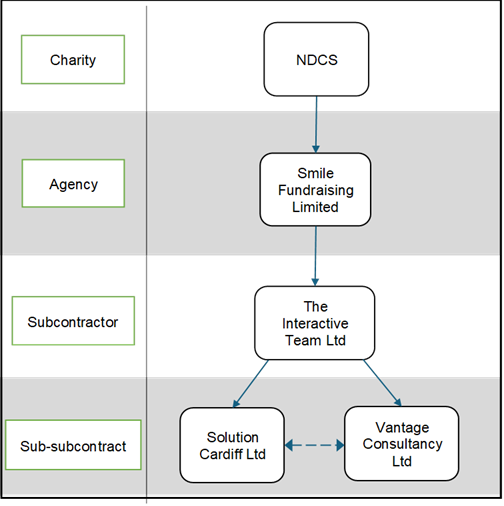
NDCS, Smile Fundraising and the Interactive Team engaged constructively with the investigation. The charity provided comprehensive and helpful information and maintained open, constructive dialogue with us throughout the process. Vantage Consultancy and Solution Cardiff did not respond to us, and correspondence sent to their registered addresses was returned. At the time of our decision, both companies had ceased trading and were recorded as dissolved.
The charity told us that it had ended its relationship with the two sub-subcontractors before the journalist’s information was published. It also provided evidence that, once concerns were identified, it took steps to strengthen its oversight arrangements. These included additional compliance discussions with its agency, changes to how new fundraisers were supported to understand the pay model, and a benchmarking exercise to review remuneration approaches.
Our decision
Behaviour when Fundraising
We found no meaningful distinction between the fundraisers working for Vantage Consultancy and those listed as working for Solutions Cardiff. We also found that the video footage provided by the undercover journalist showed both sub-subcontractors engaging in persistent and unreasonable fundraising, attempting to fundraise from a potentially vulnerable individual and making deliberately misleading claims. On this basis, we found that both Vantage Consultancy and Solutions Cardiff had breached the code regarding the standards expected of those actively involved in face-to-face fundraising activities.
However, we acknowledge that the video footage provided by the undercover journalist did not show any fundraising for NDCS, and the charity has confirmed that the fundraiser in the video had previously been banned from its fundraising campaigns. Therefore, we have not held the charity responsible for the poor fundraising behaviours depicted in the video or any resulting non-compliance relating to that section of the code.
We found that while the charity conducted appropriate due diligence on Smile (who were the lead agency the charity contracted), subsequent checks on subcontractors and sub-subcontractors within Smile’s network were insufficient to meet the Code’s requirement. The agency was responsible for subcontractor due diligence, but it was unclear whether this extended to the sub-subcontractors Vantage and Solution, or to their fundraisers. Although subcontractors were required to be members of the Chartered Institute of Fundraising (CIOF), Vantage and Solution were not members. Given that the charity is ultimately responsible for all those within its agency network, we considered the charity’s due diligence arrangements were insufficient to ensure full compliance with the code.
Third party fundraising arrangements and contracts
We found that the contract between the charity and the agency was detailed and included clear expectations about compliance with the code and monitoring arrangements.
The charity told us it had sought assurances from the agency that relevant obligations were being passed on. However, at the time of the fundraising activity we examined, the charity did not routinely review or approve the contracts used beyond its direct relationship with the agency. This was not an unusual practice within the sector at the time. We also found that the charity was not fully aware of the subcontractor's role in the supply chain until specific questions were asked during our investigation.
We concluded that the charity’s expectations were not consistently or clearly reflected in contractual arrangements throughout the supply chain. We found that this reduced the charity’s ability to exercise effective oversight across the full supply chain. On this basis we found the charity breached the code.
Monitoring and Compliance
We recognised that monitoring activity did take place. The charity showed a clear approach to the monitoring and compliance of the agency’s activities. This included the use of complaint data and actions taken when concerns were identified. For example, increased complaint levels linked to the two sub-subcontractors were identified, and the agency ended its relationship with them. We also saw evidence of the sub-contractors monitoring tools, including training and complaints trackers.
However, as outlined in the previous section, we concluded that these monitoring arrangements were not sufficiently supported by clear contractual requirements across the supply chain. On this basis, we found the charity breached the code.
Complaint handling and paying fundraisers
We found no breach of the code in relation to complaints handling (standard 2.4.4), as we saw evidence that complaints were recorded, considered and responded to appropriately. Following further representations and additional evidence, we also found no breach of the standards relating to paying fundraisers (standards 2.5.3 and 2.5.5). In particular, we did not find sufficient evidence that the pay arrangements in place, on their own, caused fundraisers to act in a way that breached the code.
Code sections considered
Code of Fundraising Practice, version effective 1 October 2019 (last updated 4 June 2021):
Section 1 Behaviour when Fundraising
- Standard 1.1.1: breach identified (Sub-subcontractor)
Section 1.2 Asking for support
- Standard 1.2.1: breach identified (Sub-subcontractor)
- Standard 1.2.2: breach identified (Sub-subcontractor)
Section 1.3 Treating people fairly
- Standard 1.3.7: breach identified (Sub-subcontractor)
- Standard 1.3.8: breach identified (Sub-subcontractor)
Section 2.1 Responsibilities of charitable institutions
- Standard 2.1.1: breach identified (charity)
Section 2.4 Complaints
- Standard 2.4.4: no breach identified (charity)
Section 2.5 Paying fundraisers
- Standard 2.5.3: no breach identified (charity)
- Standard 2.5.4: no breach identified (charity)
- Standard 2.5.5: no breach identified (charity)
Section 7.1 Responsibilities when working with Professional Fundraisers, commercial participator's and partners
- Standard 7.1.1: breach identified (charity)
Section 7.2 Due diligence and contracts
- Standard 7.2.4: breach identified (charity)
- Standard 7.2.9: breach identified (charity)
Section 7.3 Monitoring and compliance
- Standard 7.3.1: breach identified (charity)
- Standard 7.3.2: breach identified (charity)
Section 8.1 Behaviour when collecting money or property
- Standard 8.1.1: breach identified (Sub-subcontractor)
Our recommendations
We recommend that NDCS should:
- Review its procedures to ensure that when onboarding new subcontractors and sub-subcontractors, NDCS is able to apply the same level of scrutiny, monitoring and training that it would for agency-level organisations.
- Review supply chain contracts for all its subcontractors and sub-subcontractors to ensure that these fully comply with the code.
- Where any non-compliant contracts are found, conduct a thorough review of the arrangements to determine if it is still appropriate to use that contractor.
- Provide us with a copy of the report following its benchmarking exercise and outline what steps it will take following on from this.
- Consider implementing longer visits to its fundraising site offices and consider introducing measures allowing it to visit the organisation without prior notice.
- Review its processes for monitoring complaints received by its suppliers and introduce or strengthen processes for:
- Prioritising those that involve a breach or potential breach of the code.
- Analysing the frequency and root causes of high-priority complaints, to better identify any systemic poor fundraising practice.
- Auditing to ensure NDCS is aware of all complaints received.
- Consider the findings of the Fundraising Regulator’s Market Inquiry report to identify if there is further learning in relation to its in-person fundraising activity.
Whilst we did not find direct breaches against Smile and the Interactive Team, given the concerns raised we have felt it necessary to make the following recommendations
We recommend that Smile should:
- Review and update its processes for responding to complaints received about its fundraisers.
- Update its processes to ensure that its agreements with its fundraising suppliers include all terms and information required by the code.
- Introduce processes to ensure that the same is true of any agreements that involve further subcontracting arrangements.
- Update its processes to ensure that where there is further subcontracting, that the companies or individuals receive the same level of due diligence and are held to the same contractual standards as firms it works with directly.
We recommend that Interactive Team should:
- Review and update its processes for responding to complaints received about its fundraisers.
- Update its processes to ensure that its agreements with its fundraising suppliers include all terms and information required by the code.
- Update its processes to ensure that where there is subcontracting, that the companies or individuals that are fundraising receive appropriate due diligence and are held to the contractual standards required by the code.
We have not made recommendations for Vantage Consultancy and Solution Cardiff as both companies have ceased trading.
Outcome
NDCS confirmed that it had already ended its relationship with the two sub-subcontractors before the journalist's information was published. NDCS also provided evidence of steps taken to strengthen its approach following concerns raised, including enhanced compliance activity with its agency and work to review remuneration practices. We will follow up with the charity and its agents during the post-investigation compliance phase to understand how our recommendations have been implemented and to support learning for future third-party fundraising arrangements.